
Uruguayan officials and ICC President unveil artwork donation to International Criminal Court
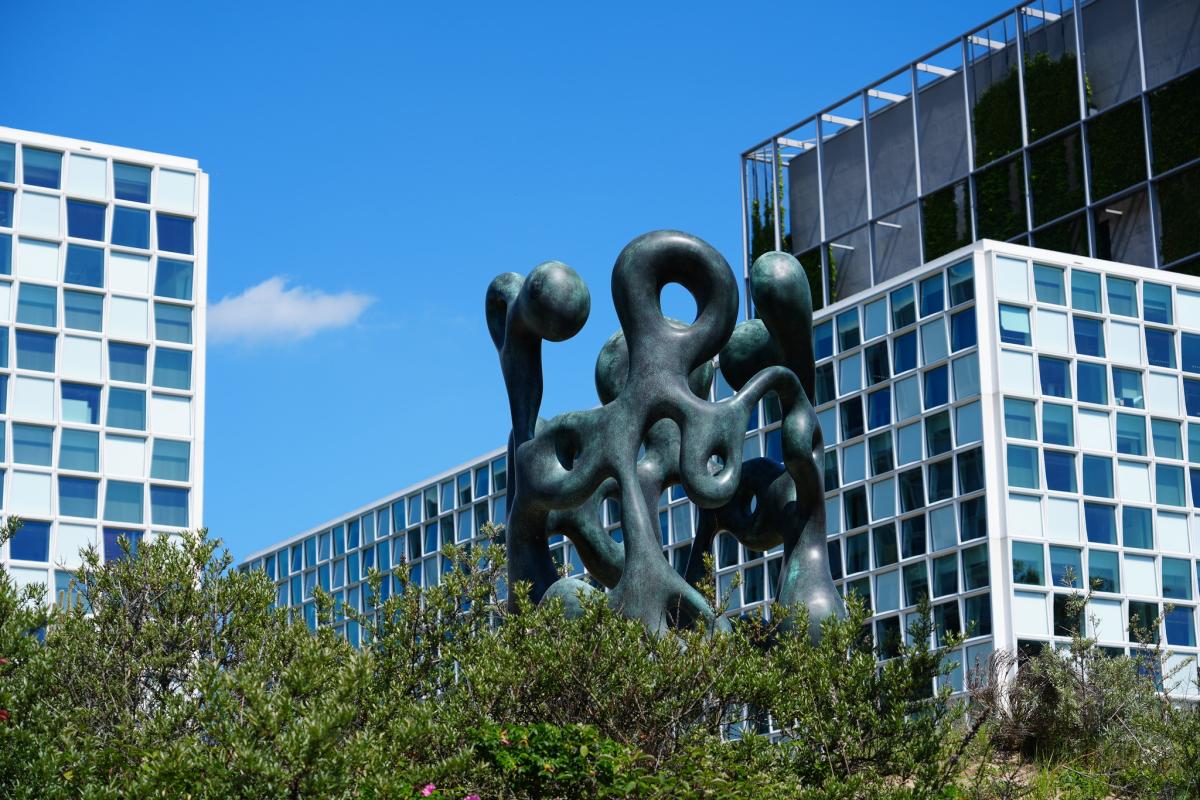
On 22 May 2026, H.E. Álvaro Enrique González Otero, Ambassador of Uruguay to the Netherlands, together with Judge Tomoko Akane, President of the International Criminal Court (ICC), unveiled the sculpture “El Tótem de la Tribu Humana” (The Totem of the Human Tribe) at the ICC headquarters in The Hague, The Netherlands. The artwork, created by renowned Uruguayan artist Roberto Vivo, was donated by the Government of Uruguay to the ICC.
The sculpture, previously exhibited at the Venice International Art Biennale, celebrates fraternity, diversity, and international justice. It invites reflection on the pursuit of peace for the benefit of humanity as a whole.
Judge Tomoko Akane, ICC President, stated: “The Human Tribe Totem is particularly fitting for the International Criminal Court because it speaks to our shared humanity. Its symbolism reminds us that the ICC was created not for the interests of any single nation or region, but for humanity as a whole. At a time when conflicts and human suffering continue to make headlines, this artwork serves as a powerful reminder of the importance of solidarity, accountability, and the rule of law. It reminds us that justice is not an abstract principle, but a responsibility shared by all nations and peoples.”
H.E. Álvaro Enrique González Otero, Ambassador of Uruguay, said: “If there is one place where this idea acquires concrete meaning, it is precisely here, at the International Criminal Court. An institution that represents the collective effort of States to affirm that, beyond geographical, cultural, political and/or religious differences, there exist fundamental values that must be safeguarded through law and justice. In a complex global context, marked by conflicts and growing challenges to the multilateral system, the existence of this Court reaffirms that international justice is not merely an abstract aspiration, but rather a tangible commitment of the international community. The Rome Statute, whose entry into force in 2002 marked a milestone in the evolution of international law, gave shape to this unique forum — a space in which States agree to submit themselves to common rules, in the conviction that justice strengthens peace, stability, and international coexistence. Uruguay firmly supported that process from its inception and fully incorporated the provisions of the Statute into its domestic legal order through comprehensive legislation, thereby reaffirming its historic commitment to international criminal law and to the fight against impunity.”
Since the move to its new permanent premises in December 2015, the ICC received artwork donations from the Governments of Australia, Belgium, Canada, Cyprus, Denmark, Japan, Republic of Korea, Ireland, Liechtenstein, Mexico, The Netherlands, Portugal, Romania, Senegal, Slovenia, and Tunisia, representing their cultural heritage as well as reflecting the mandate of the Court.
For further information, please contact the ICC Public Affairs Unit: [email protected]. You can also follow the Court’s activities on Twitter/X, Facebook, YouTube, Instagram and Flickr.
El 22 de mayo de 2026, S.E. Álvaro Enrique González Otero, embajador de Uruguay ante los Países Bajos, y la jueza Tomoko Akane, Presidenta de la Corte Penal Internacional (CPI), inauguraron la escultura titulada “El Tótem de la Tribu Humana” en la sede de la CPI en La Haya, Países Bajos. La obra de arte, creada por el renombrado artista uruguayo Roberto Vivo, fue donada por el Gobierno de Uruguay a la CPI.
La escultura, previamente exhibida en la Bienal Internacional de Arte de Venecia, celebra la fraternidad, la diversidad y la justicia internacional. Invita a la reflexión sobre la búsqueda de la paz en beneficio de toda la humanidad.
La jueza Tomoko Akane, Presidenta de la CPI, señaló: “El Tótem de la Tribu Humana resulta especialmente adecuado para la Corte Penal Internacional, ya que hace referencia a nuestra humanidad compartida. Su simbolismo nos recuerda que la CPI no se creó en interés de una sola nación o región, sino de la humanidad en su conjunto. En un momento en que los conflictos y el sufrimiento humano siguen acaparando los titulares, esta obra de arte sirve como un poderoso recordatorio de la importancia de la solidaridad, la rendición de cuentas y el estado de derecho. Nos recuerda que la justicia no es un principio abstracto, sino una responsabilidad compartida por todas las naciones y pueblos.”
S.E. Álvaro Enrique González Otero, embajador de Uruguay, indicó: “Si hay un lugar donde esta idea cobra un significado concreto, es precisamente aquí, en la Corte Penal Internacional. Una institución que representa el esfuerzo colectivo de los Estados por afirmar que, más allá de las diferencias geográficas, culturales, políticas y/o religiosas, existen valores fundamentales que deben salvaguardarse mediane el derecho y la justicia. En un contexto global complejo, marcado por conflictos y crecientes desafíos al sistema multilateral, la existencia de esta Corte reafirma que la justicia internacional no es solo una aspiración abstracta, sino más bien un compromiso tangible de la comunidad internacional. El Estatuto de Roma, cuya entrada en vigor en 2002 marcó un hito en la evolución del derecho internacional, dio forma a este foro único: un espacio en el que los Estados acuerdan someterse a normas comunes, con la convicción de que la justicia fortalece la paz, la estabilidad y la convivencia internacional. Uruguay apoyó firmemente ese proceso desde sus inicios e incorporó plenamente las disposiciones del Estatuto dentro de su ordenamiento jurídico interno a través de una legislación exhaustiva, reafirmando así su compromiso histórico con el derecho penal internacional y con la lucha contra la impunidad.”
Desde que se mudó a sus nuevas instalaciones permanentes en diciembre de 2015, la CPI ha recibido obras de arte de los gobiernos de Australia, Bélgica, Canadá, Chipre, República de Corea, Dinamarca, Eslovenia, Irlanda, Japón, Liechtenstein, México, Países Bajos, Portugal, Rumania, Senegal y Túnez, que representan sus respectivos patrimonios culturales y reflejan el mandato de la Corte.
Para más información, por favor contacte a la Unidad de Asuntos Públicos de la CPI: [email protected] . También puede seguir las actividades de l Corte en Twitter/X, Facebook, YouTube, Instagram y Flickr.