
Launch of the national “Calling African Female Lawyers” campaign in Senegal
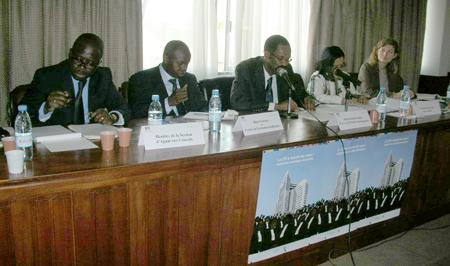
On Monday, 22 November, 2010, the national campaign for Senegal to increase the number of African female lawyers authorised to practice before the International Criminal Court (ICC) was launched in Dakar. The campaign, which is part of a broader, international six-month campaign jointly conducted by the ICC and the International Bar Association (IBA), aims to encourage experienced female lawyers from Senegal to play a crucial role at the ICC by representing victims or defendants in proceedings before the Court.
The campaign in Senegal started off with two information sessions: In the morning, a session was organised with the Judiciary Training Centre [Centre de formation judiciaire] in Dakar, in which around thirty female magistrates participated; and a second session was held in the afternoon with the Senegalese Bar Association, gathering together forty lawyers.
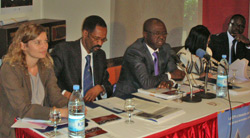
In both meetings, panel discussions – the first being chaired by the Director of the
Image
|
| Left to right: Caroline Maurel, Associate Outreach Officer of the ICC ; Didier Preira, Deputy Registrar of the ICC; Alioune Badara Fall, President of the Senegalese Bar Association; Hélène Cisse, Counsel before the ICC ; Abdoul Aziz Mbaye, Assistant Legal Officer, Counsel Support Section of the ICC © ICC-CPI |
The ICC Deputy Registrar, Didier Preira, stressed that applications from qualified African female lawyers would be given priority throughout the campaign period until the end of 2010. “Achieving equal representation of female counsel is essential for the ICC”, he said, adding that “the right to be assisted by counsel is a core element for both defendants and victims. While any suspect or accused and victim should be able to choose their counsel from a pool of highly qualified lawyers, they should also be able to do so with regard to their own preference for either male or female counsel. This is particularly important as it relates to victims of sensitive crimes such as sexual violence against women and gender crimes”.
Hélène Cisse, a female Senegalese lawyer on the ICC List of Counsel, who is representing victims before the ICC in several cases, stated that “African female lawyers have a crucial role to play: they should participate in the construction of international criminal law in order to reinforce the fight against impunity for perpetrators of the most serious crimes, in particular rapes, that constitute war crimes and crimes against humanity”.
Each event concluded with a session of questions and answers, during which the participants engaged in lively discussions.
The “Calling African Female Lawyers” campaign was internationally launched on 12 May, 2010 at the Court’s headquarters in The Hague. To date, women counsel are still under-represented on the ICC List of Counsel, representing only 19 percent of the 350 counsel on the list. In particular, the ICC recognises the need to increase the number of women counsel from African countries. Of the 116 African counsel on the list, only 16 of them are women.
Electronic copies of the information package for this campaign can be downloaded from the campaign website at http://www.femalecounsel.icc-cpi.info/.
For further information, please contact Fadi El Abdallah, Associate Legal Outreach Officer, by telephone at: +31 (0)70 515-9152 or by e-mail at: [email protected].
You can also follow the Court’s activities on YouTube and Twitter.