
ICC Registrar launches series on victims’ rights and reparations, hosts working session with Colombian experts
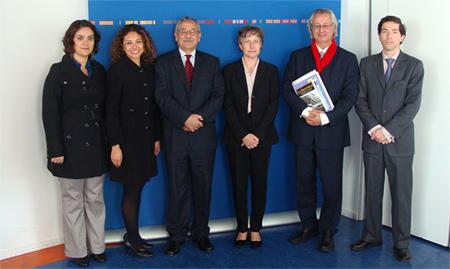
On 25 October, as the first event in a series on victims’ rights to reparations, the Registry of the International Criminal Court (ICC) hosted a working session, with presentations by the Colombian National Commission for Reparation and Reconciliation (CNRR, as abbreviated in Spanish). The session provided an in-depth analysis on how reparations and victims’ rights are approached both in judicial proceedings and administrative programs in relation to serious international crimes committed in Colombia.
The ICC Registrar, Ms Silvana Arbia, opened the session by highlighting one of the Rome Statute’s key features: the recognition of the ICC’s restorative function as well as its punitive function. She explained that the Court aims ‘to ensure that as many victims as possible are able to exercise their rights as regards reparation and to benefit from assistance. To date, there is already jurisprudence on modalities of victims’ participation at different stages of the proceedings, but the Chambers have not had the opportunity to decide on reparations issues.’ She added that, as of 30 September, 2010, the Registry has received a total of 734 applications from victims in five situations requesting to be granted their rights for reparations. The Registrar thanked the CNRR experts for accepting her invitation to present their experiences on these issues.
The Colombian transitional justice experience
The President of the CNRR, Mr Eduardo Pizarro, offered an in-depth analysis of the Colombian experience with regard to reparations, in the context of implementing measures related to Colombia’s Peace and Justice transitional law. ‘The adoption of this law has engendered many discussions on how best to grant reparations to the thousands of registered victims, either accredited in the judicial processes or those participating in the administrative reparation routes’. Many lessons can be learned both from Colombia’s successes and mistakes, he said.
In the course of the session, Commission experts gave the following presentations on different aspects of the reparation process in Colombia:
-
Comprehensive approaches to victim’s reparations, by Professor Eduardo Pizarro, President, CNRR
-
The differential approach towards groups with particular needs, such as sexual and gender crimes, by Ms Eliana Rueda, Adviser to the Commission, CNRR
-
Integral reparation as a way to reconciliation, by Ms Maria Angelica Bueno, Coordinator for Reconciliation, CNRR
-
The institutional framework, by Juan Pablo Franco, Representative of the Presidential Agency for Social Action (Acción Social), CNRR
Also, Professor Ivan Orozco, Researcher in the Area of Historical Memory of the Commission, presented the distinct mandates of the Peace and Justice process with regard to victims’ rights to truth and justice. He emphasized the importance of historical truth. In his view, one of the most significant parts of the process is to enable Colombians to learn the truth, through emblematic cases addressing situations in which victims’ rights have been abused, in order to prevent the recurrence of crimes. Eight books on such cases have already been published by the Commission.
The Colombian delegation also held bilateral meetings with Vice-President Judge Hans-Peter Kaul and representatives of the Office of the Prosecutor.
For further information, please contact Fadi El Abdallah, Associate Legal Outreach Officer, on +31 (0)70 515-9152 or at fadi.el-abdallah@icc-cpi.
The ICC’s activities can also be followed through YouTube and Twitter