
ICC President addresses United Nations General Assembly
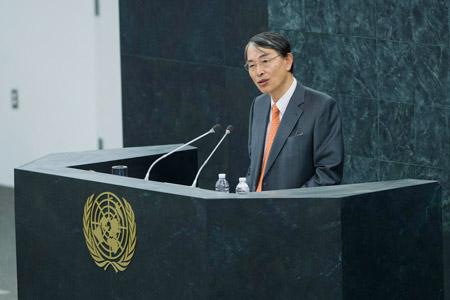
On 31 October 2013, the President of the International Criminal Court (ICC), Judge Sang-Hyun Song presented the Court’s annual report to the United Nations (UN) General Assembly in New York (United States). Addressing the Assembly, President Song expressed the ICC’s deep gratitude for the UN’s steadfast support of the Court in the context of global efforts to strengthen the rule of law and to promote peace, security and human rights around the world. He highlighted the importance of States’ cooperation with the ICC, and appealed to those States which have not yet joined the Rome Statute to give active consideration to doing so.
“In the words of the Rome Statute’s preamble, the grave crimes under the ICC’s jurisdiction ‘threaten the peace, security and well-being of the world’. It is no difficult to see why. Mass murder, the use of armed force against civilians, deportation of populations, the use of child soldiers, rape as a weapon of war – these are atrocious acts which inflict irreparable suffering, often across generations”, ICC President Song stated.
He stressed that the ICC’s success in suppressing impunity ultimately depends on the support of States. “In five years’ time, many ad hoc courts and tribunals will have closed their doors. The ICC’s role in the global efforts for peace, security and the prevention of mass atrocities will be even more pronounced than it is today”, President Song stated.
President Song also emphasised that the ICC has the duty to observe the legal framework set by States and asked the other stakeholders of the ICC system to uphold the integrity of the Rome Statute, respecting the roles assigned to each entity under the Statute. “Whereas the Assembly of States Parties can consider legislative issues and discuss political questions, the ICC must remain an independent, judicial institution”, he added.
ICC President Song provided the UN General Assembly with an update on key institutional developments and judicial proceedings since his last report in November 2012. In the past year, the Prosecutor has opened an eighth investigation, in Mali, and is conducting eight further preliminary examinations around the world with the aim of determining whether the opening of a formal ICC investigation is warranted. The Court has issued its first judgment of acquittal, which is now on appeal. Two arrest warrants were unsealed and one suspect surrendered to the Court. Three trials are continuing and two are set to start soon. Several important decisions have been issued, breaking new legal ground in the Court’s jurisprudence.
Parallel to the judicial proceedings at the Court, the ICC’s Trust Fund for Victims currently supports 28 projects that reach an estimated 110,000 victims and their families in northern Uganda and the eastern part of the Democratic Republic of the Congo.
Of these beneficiaries, over 5,000 are survivors of sexual and gender-based violence. President Song thanked those States that have already generously supported the ICC’s Trust Fund for Victims, and called upon others to consider doing so, for the benefit of the victims of atrocious crimes.
President Song also recalled that since November 2012, Côte d’Ivoire has become the 122nd State Party to the Rome Statute, and an additional nine States Parties have ratified the amendments to the Rome Statute on the crime of aggression, and ten States Parties have ratified the amendments which make the use of chemical weapons in non-international conflicts a war crime punishable by the ICC. Congratulating those countries, the President encouraged all States who have not already done so to consider ratification of these instruments and to help strengthen the international fight against impunity through the Rome Statute system.
The International Criminal Court is an independent, permanent court that tries persons accused of the most serious crimes of concern to the international community as a whole, namely the crime of genocide, crimes against humanity, war crimes and the crime of aggression.
ICC President Speech at the United Nations General Assembly – 31 October 2013
Ninth Report of the Court to the UN for 2012/13
For further information, please contact Fadi El Abdallah, Spokesperson and Head of Public Affairs Unit, International Criminal Court, by telephone at: +31 (0)70 515-9152 or +31 (0)6 46448938 or by e-mail at: [email protected].
You can also follow the Court’s activities on YouTube and Twitter