
ICC President Addresses Russian Lawyers in St Petersburg
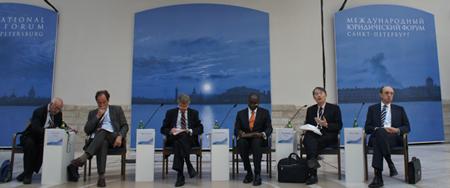
The President of the International Criminal Court (ICC), Judge Sang-Hyun Song, addressed Russian lawyers in St. Petersburg this Thursday 16 May 2013 at the invitation of the Minister of Justice of the Russian Federation, Mr. Alexander Konovalov.
President Song told the Saint Petersburg International Legal Forum that the ICC had become an international organisation of major significance, and noted Russia’s recent expressions of support in a number of forums, including within the United Nations Security Council.
The Russian Federation has signed the Rome Statute which establishes the ICC, but is yet to ratify the treaty.
“While the decision whether to ratify the Rome Statute is solely for every sovereign State to make, Russia will be most warmly welcomed if and when it decides to take that important step,” President Song said.
The President stressed the critical role of the ICC as a ‘failsafe court’ which intervenes only if states fail to address crimes within their domestic legal systems, known as the principle of complementarity.
Addressing students at a separate event at St Petersburg State University, President Song said the main value of the International Criminal Court “is not in the punishment of past acts, but in the prevention of future crimes” and elaborated on different forms of the ICC’s deterrent impact.
President Song visited St. Petersburg as part of a delegation of international legal officials from The Hague, sponsored by the Dutch Peace and Justice Project. The delegation included the Presidents of the International Court of Justice and of the International Criminal Tribunal for the Former Yugoslavia, and the Secretaries-General of the Permanent Court of Arbitration and of the Hague Conference on Private International Law.
While in St Petersburg, President Song met, among others, with the Chairman of the Russian Constitutional Court, Judge Valery Zorkin, the President of the Russian Chapter of International Law Association, Dr. Anatoly Kapustin, and with the Justice Ministers of Kazakhstan and Thailand.
The International Criminal Court, established in 2002 and supported by an Assembly of 122 States Parties, is a permanent international court whose primary purpose is to help to put an end to impunity for the perpetrators of the most serious crimes of concern to the international community as a whole, namely genocide, crimes against humanity and war crimes, thus contributing to the prevention of such crimes.
For further information, please contact Fadi El Abdallah, Spokesperson and Head of Public Affairs Unit, International Criminal Court, by telephone at: +31 (0)70 515-9152 or +31 (0)6 46448938 or by e-mail at: [email protected].
You can also follow the Court’s activities on YouTube and Twitter