
ICC President Song meets with Tanzania’s President Jakaya Kikwete and other Senior Representatives of the Tanzanian Government
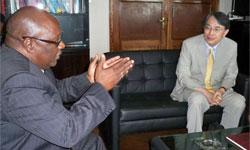
Today, 2 June 2009, as part of his official visit to African States Parties, President Song met in Dar es Salaam with Tanzania’s President Jakaya Kikwete.
During the meeting, he updated President Kikwete on the latest developments at the Court and highlighted the need for States to cooperate with the Court in order to ensure the success of the Court’s mandate.
President Kikwete reassured President Song of Tanzania’s commitment and support for the ICC and its efforts to ensure justice.
President Song also held meetings with the Minister for Foreign Affairs, Bernard Kamillius Membe, and the Minister of Justice and Constitutional Affairs, Mathias M. Chikawe, accompanied by the Director of Public Prosecutions, Eliezer Mbuki Feleshi, who reiterated that Tanzania remains convinced of the important role that the ICC plays as a judicial institution.
During the meetings, President Song raised the importance of the implementation of the Rome Statute into domestic legislation. “The ICC is a Court of last resort and under the system of complementarity, primary responsibility to investigate and prosecute crimes falls on States,” said President Song. He also stressed the importance for States Parties to cooperate with the ICC, especially in areas such as enforcement of sentences and relocation of witnesses.
President Song also recalled the important role that Tanzania and other African countries played prior to and during the 1998 Rome Conference that established the Court. “Perhaps, without Africa’s support, the Rome Statute would never have been adopted” said President Song. He also highlighted the significant contribution made by Africans in setting up the Court after the entry into force of the Statute in July 2002.
“The ICC has come a long way since its establishment six years ago and is now a fully functional judicial institution carrying out its mandate of ensuring justice for victims of the most heinous crimes. In doing so, the ICC is guided only by the evidence and by the law,” said President Song.
The International Criminal Court is an independent, permanent court that investigates and prosecutes persons accused of the most serious crimes of international concern: genocide, crimes against humanity and war crimes. It was established by an international treaty, the Rome Statute.
To date, three States Parties to the Rome Statute – Uganda, the Democratic Republic of the Congo and the Central African Republic – have referred situations occurring on their territories to the Court. In addition, the Security Council has referred the situation in Darfur, Sudan – a non – State Party.
For further information please contact Ms Sonia Robla, Head of Public Information and Documentation Section at +31 (0)70 515-8089 or (0)6 46 44 87 26 or at [email protected]