
The ICC President opens Commonwealth meeting on the ICC
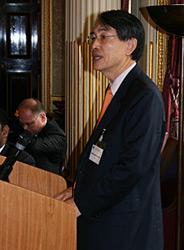
On 5 October, 2010, the President of the International Criminal Court (ICC), Judge Sang-Hyun Song, called on the Commonwealth countries that are States Parties to the Rome Statute to use their good relations with Commonwealth non-States Parties ‘to highlight the benefits of membership in the Rome Statute system’ and to offer technical assistance to facilitate their ratification of the Statute. Thirty-four Commonwealth countries had rejoined the Rome Statute system, three of them having ratified it this year.
Judge Song addressed the audience at the opening of the ‘Commonwealth meeting on the International Criminal Court,’ organised by the Legal and Constitutional Affairs Division (LCAD) of the Commonwealth Secretariat and held from 5 to 7 October, 2010, at Marlborough House, London. During the meeting, several crucial aspects of the system created by the Rome Statute of the ICC will be discussed. In his opening speech, Judge Song congratulated the Commonwealth Secretariat on its consistently excellent work as a facilitator of technical assistance and a catalyst in promoting ratification and full implementation of the Rome Statute among the Commonwealth countries.
President Song described the achievements of the ICC, and explained the purely judicial nature of its mandate, its independence, geographical diversity, and, most importantly, the guarantees the ICC offers for a fair trial and the strong emphasis put on the position of victims participating before the Court. He also discussed the existence of several misperceptions about the Court and encouraged the Commonwealth countries that are not States Parties to the Rome Statute to seek additional information about the ICC if necessary and to consider ratification with an open mind. Twenty of the fifty-four Commonwealth States have so far not joined the ICC, although five of them have signed the Statute.
Judge Song stressed that the Rome Statute reflects the conviction of the majority of the world’s States that genocide, crimes against humanity, war crimes and the crime of aggression cannot be tolerated. Judge Song also emphasised that the ICC is a court of last resort and that it is the duty of every State to exercise its national criminal jurisdiction over those responsible for such crimes. ‘Impunity can be ended, but only with decisive action and consistent commitment’, declared the ICC President.
For further information on the Commonwealth meeting on the International Criminal Court, please contact Tom Baird, from the Communications & Public Affairs Division, Commonwealth Secretariat, at +44 (0) 20 7747 6136 or at [email protected].
For further information on the ICC, please contact Sonia Robla, Head of the Public Information and Documentation Section on +31 (0)70 515-8089 or on +31 (0) 6 46 44 87 26 or at [email protected].
The ICC’s activities can also be followed through YouTube and Twitter.